Photo: Rob Windfelder | Flyers Nitty Gritty
After one of the numerically most impressive late-season surges of all time to get into the playoffs and win a series last year, the Philadelphia Flyers have had an extremely underwhelming first quarter of the 2026-27season.
And despite all the drama surrounding the team both on and off the ice right now, things still might not be as bad as you think.
After getting blown out by the Penguins on opening night, the Flyers dropped eight more in a row — and brutally, all but one were to Eastern Conference rivals.
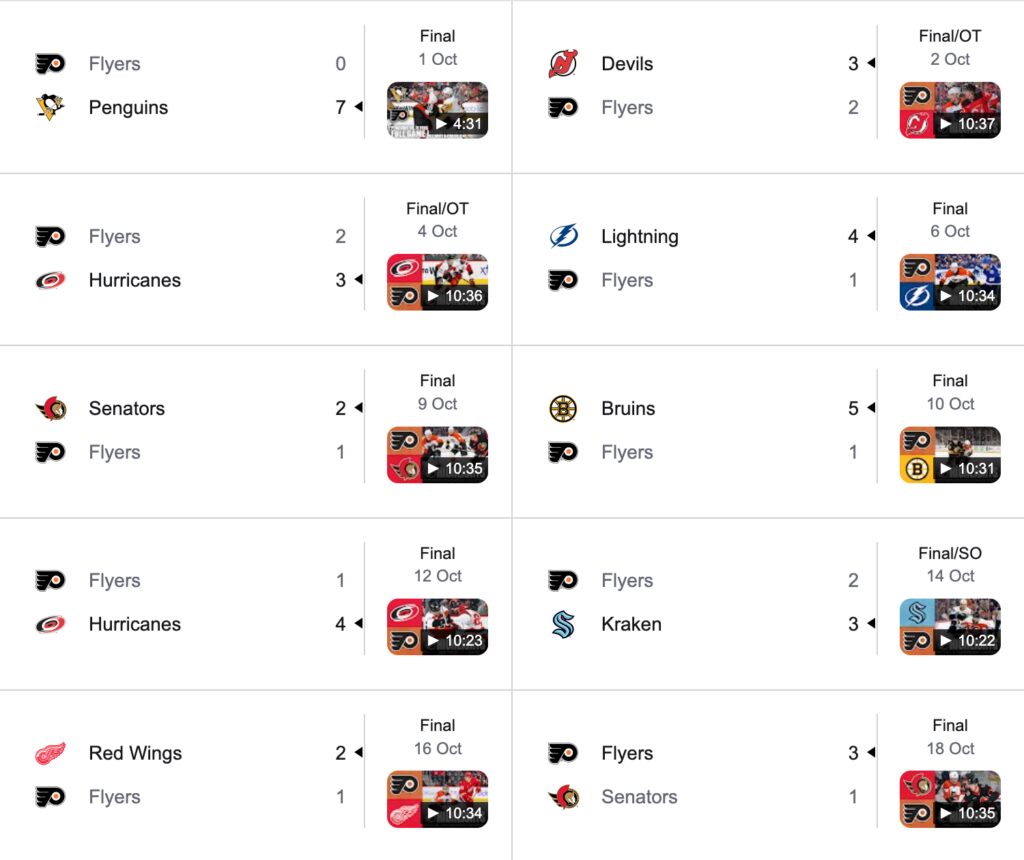
Throughout the course of those nine losses, the Flyers gave up a staggering 33 goals, while potting just 11 of their own – good for a goal differential of -22 over that span.
But since then, beginning with their Oct. 18 win over the Ottawa Senators, the Flyers have gone 6-4-3 and mounted a goal differential of +1 – scoring 40 goals and giving up 39.
Though the ship has steadied, it’s not necessarily a record worth writing home about. But what’s more interesting is and might give fans a reason to hold onto hope a little bit longer is looking deeper into how they’re winning and losing these games.
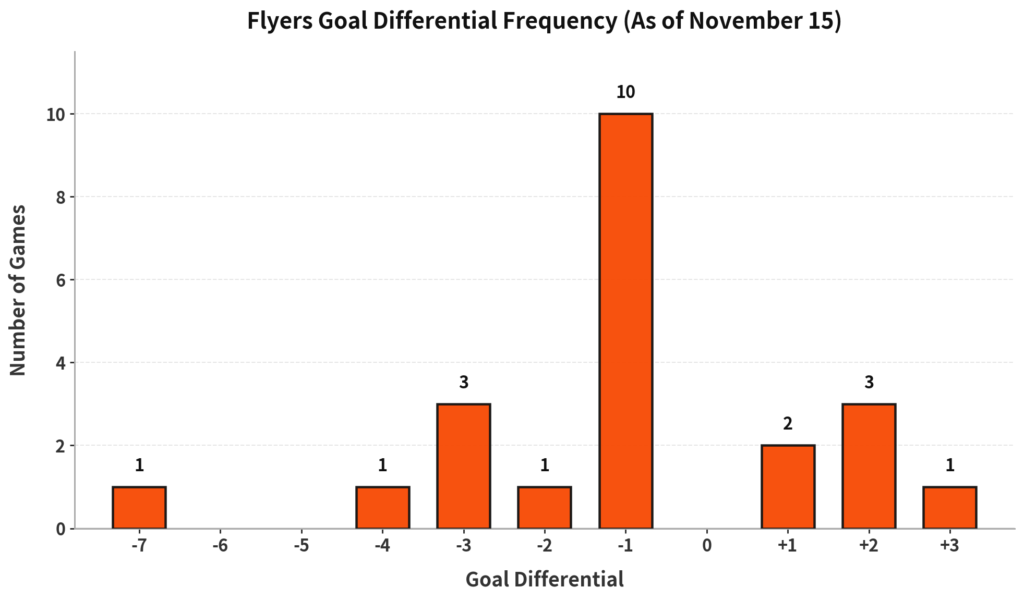
Of the Flyers’ 16 losses, 10 have been 1-goal games, and six of those ten were overtime losses.
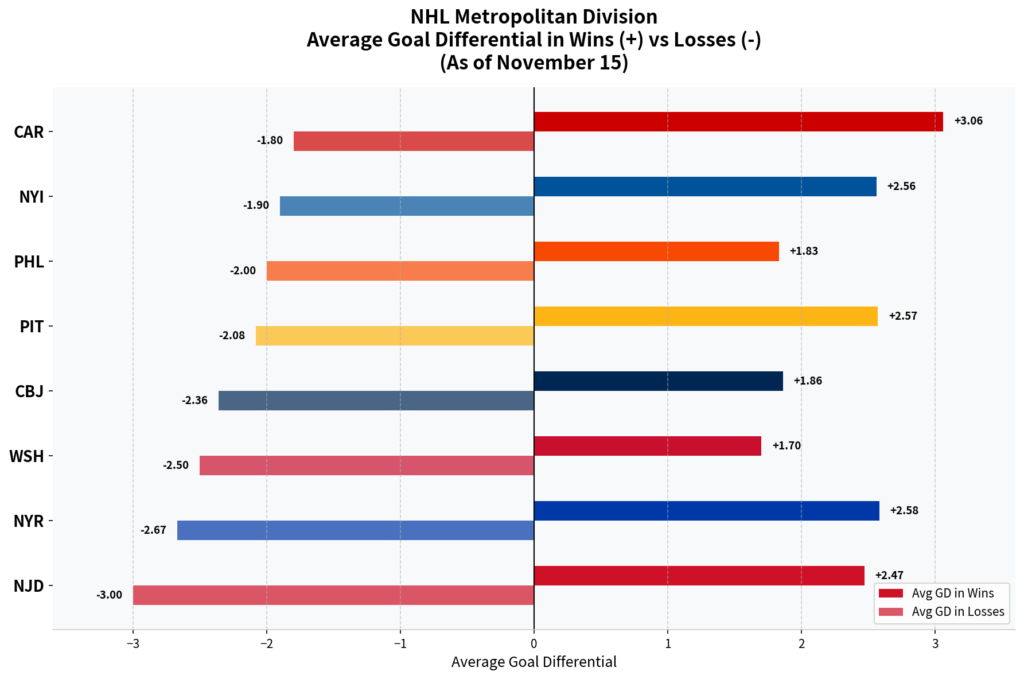
Though it’s a small sample size, in their six wins, the Flyers’ goal differential is, on average, +1.83. In their 16 losses, an unfortunately much larger sample size, their goal differential average is -2.00.
On its face, they’re losing in losses by more than they’re winning in wins – not impressive. But the Pittsburgh game is obviously an outlier – in both magnitude and timing. It was the first game of the season, and the Flyers gave up an unusually high seven goals and scored zero. It’s the only game this season the Flyers haven’t scored a goal, and the only game they’ve given up more than five (something they’ve done three times).
If we remove this one game from the sample, their average goal differential per loss drops to -1.67 – best in the Metropolitan Division. Even at -2.00, the Flyers would be third best of eight teams – the New York Islanders have averaged -1.90 in their losses, and the Carolina Hurricanes have averaged -1.80. But the outlier is worth removing, as no other team in the Metro has had such an uncharacteristic result yet this season.
On the other hand, the Flyers have the second-worst goal differential average in wins at +1.83, outdone by only the Washington Capitals, at +1.70.
Notably, Pittsburgh’s 7-0 win over the Flyers was quite uncharacteristic in nature for them as well, and if removed from their sample, would leave the team tied with the Flyers at +1.83.
So what does all this data tell us? More than anything, that the Flyers play a steady brand of hockey that usually results in both teams scoring few goals. That’s not news for fans, as things haven’t changed much since Philly established this play style under former Head Coach John Tortorella and has continued it under Rick Tocchet.
No matter how you slice it, whether it’s by 1 or 10 goals, a regulation loss is a regulation loss. Ten of them in 22 games is not good. But seeing how the overwhelming majority of the Flyers’ losses have been 1-goal games, six of which resulted in a standings point, it means they might not need to improve that much to start trending in the right direction.
Furthermore, with a power play that’s finally starting to score (25.8% over the last 10 games), it’s not entirely out of the question that the Flyers could start winning significantly more hockey games if they can sustain that or something near the league average, which usually hovers around 21%. By contrast, in their opening nine-game skid, the power play scored on an abysmally low 7.7% of its chances.
Having only six wins has felt extremely bleak for fans, especially since an overtime loss elicits a much more lukewarm immediate feeling – but those six loser points have arguably kept the team afloat thus far. At the time of analysis, the Flyers are riding a four-game point streak and seven points out of a playoff spot.
The old cliché is true: you can’t make the playoffs in the first month of the season, but you can miss them. It’s a pretty tough hole the team is going to have to climb out of if they’re going to be playing spring hockey, but with 60 games left and a tendency to lose small, the Flyers still have a shot at doing just that.
About Author